

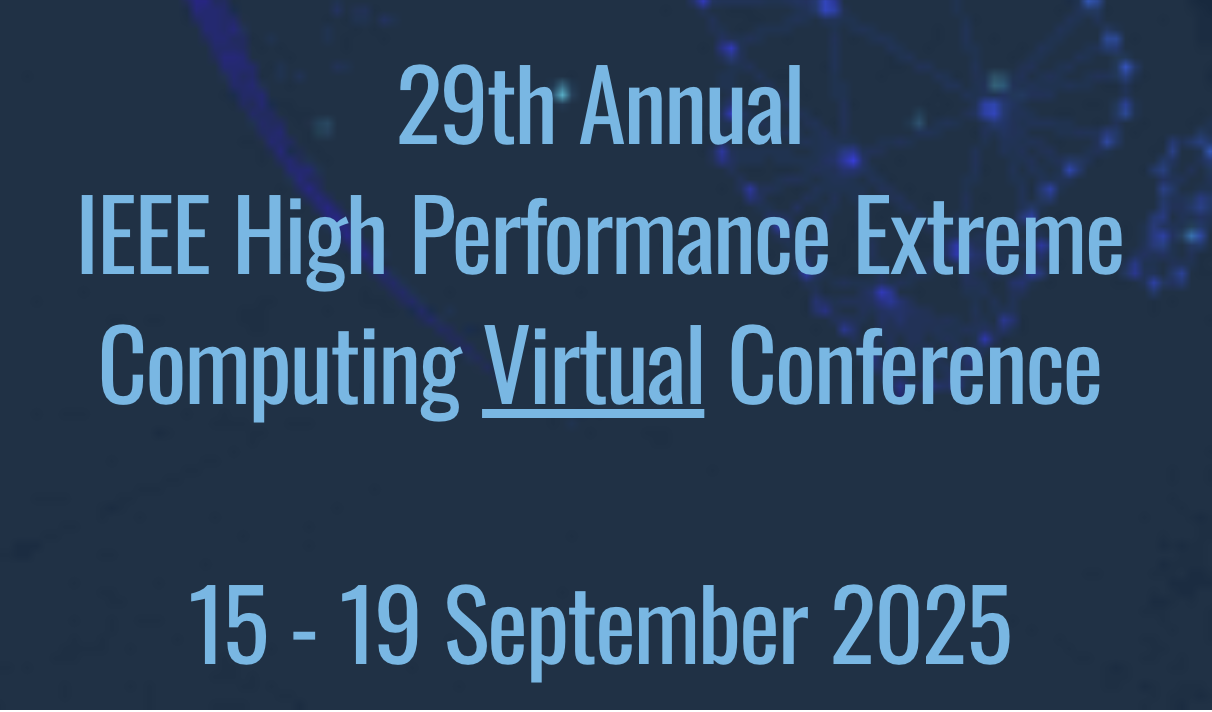
IEEE High Performance Extreme Computing Conference (HPEC 2025) showcases breakthroughs in AI, HPC, and quantum technologies.
Reporting by Helen Hill for MGHPCC
The 29th Annual IEEE High Performance Extreme Computing (HPEC) Conference successfully concluded after five days of cutting-edge discussions and presentations on the future of high-performance computing (HPC) and embedded systems. Organized by MIT Lincoln Laboratory, HPEC remains the leading forum for researchers, industry experts, and government innovators driving advancements in extreme computing.
Held virtually from September 15–19, HPEC 2025 attracted hundreds of participants worldwide, offering an inclusive platform for collaboration and knowledge exchange. The conference featured keynote addresses from distinguished leaders, technical sessions, tutorials, and poster presentations, all focused on accelerating innovation in HPC, AI, and emerging technologies.
Keynote Highlights:
Nick Rotker (MITRE) opened the event with insights on OceanAI and AI-driven marine solutions.
Prof. Julie Shah (MIT) explored Human-Machine Partnerships in High-Stakes Settings, emphasizing trust in autonomous systems.
Dr. Ashley Conard (Microsoft) addressed Building AI That Users Trust, focusing on transparency and reliability.
Joshua Patterson (NVIDIA) showcased SPACE MICE: Next-Generation Data Systems for HPC architectures.
Prof. Bill Gropp (NCSA) concluded with strategies for Performance Engineering with MPI.
Technical sessions covered a wide range of topics, including neuromorphic (or brain-inspired) AI, quantum acceleration, graph analytics, and mixed-precision computing, while tutorials provided hands-on learning in algorithm optimization and parallel programming. Poster sessions highlighted innovations in AI/ML, embedded GPU systems, and cybersecurity for HPC environments.
HPEC continued its commitment to accessibility by maintaining a virtual format, reducing barriers to participation and fostering global engagement. All accepted papers were archived in IEEE Xplore, ensuring broad dissemination of research contributions.
HPEC 2025 reaffirmed its role as a catalyst for breakthroughs in computing technologies critical to scientific discovery, national security, and industrial innovation.