Menu

Tapping into an Ocean of Data

June 19, 2013

Story by Helen Hill for MGHPCC
An MGHPCC seed fund award allowed Professor Pierre Lermusiaux and collaborators to develop multi-scale models of the marine environment off the New England coast designed to talk to one-another and interface with real-time observations.

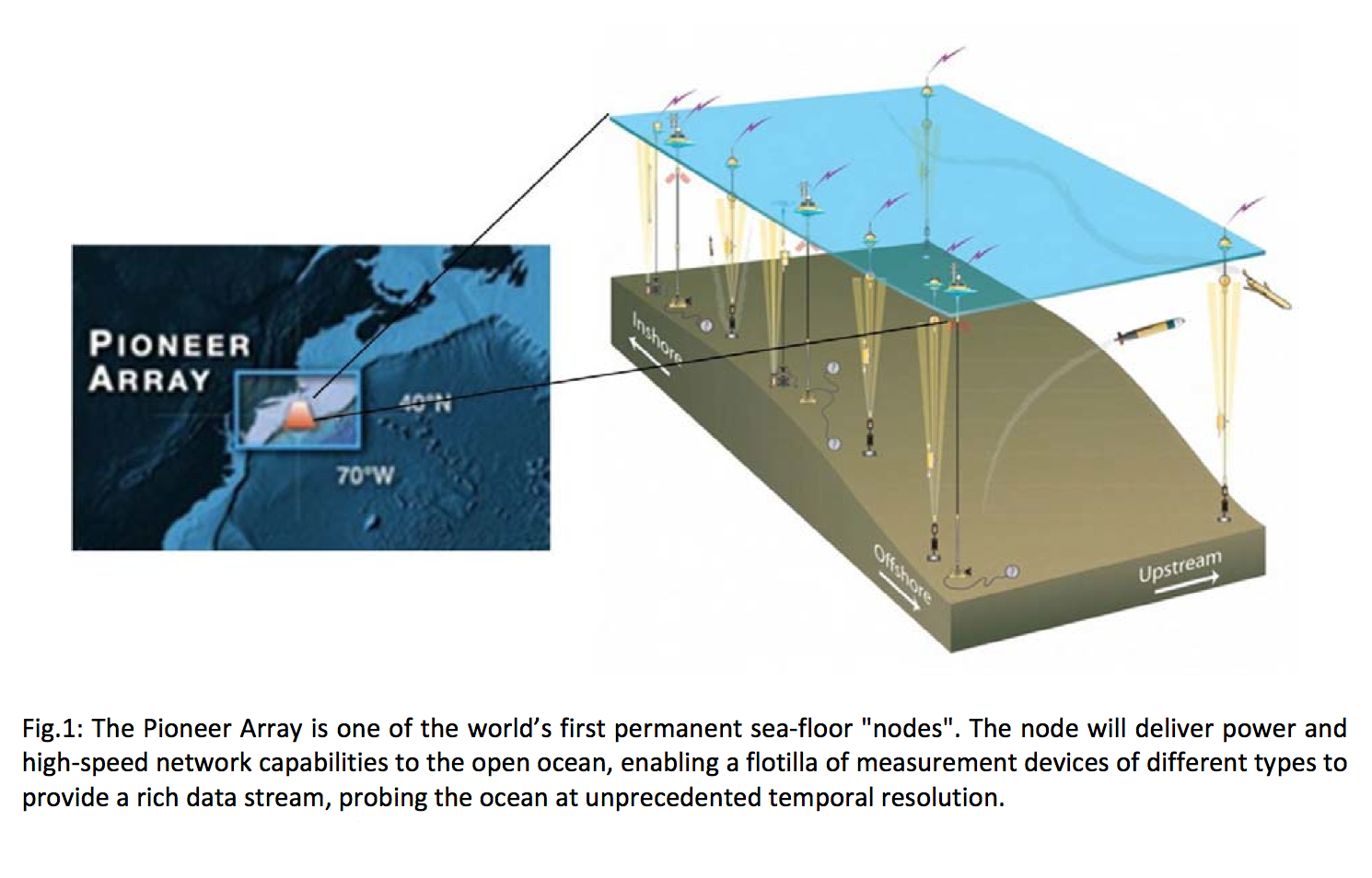
The Pioneer Array - Credit WHOI

The Pioneer Array - Credit WHOI


To complement the forthcoming deployment of a state-of-the-art underwater observation platform, 2012 seed fund researchers Chris Hill (MIT), Pierre Lermusiaux (MIT), Amala Mahadevan (WHOI), John Marshall (MIT) and Amit Tandon (UMass Dartmouth) have been collaborating to create computer models aimed at providing insights into the turbulent mixing that regulates nutrient cycle and ocean ecosystem dynamics off the New England coast where it will be sited.
The Pioneer Array, part of the NSF Ocean Observing Initiative (OOI), is the first community relocatable process-oriented observatory, the equivalent of an international cyclotron for coastal ocean science. The array will enable a flotilla of different measurement devices to provide a rich data stream of physical and biological processes in the vicinity of the shelf-break front,  a region of great importance to the oceanography and ecology of the coastal waters. Engineers in the Department of Mechanical Engineering (MechE) at MIT and at the Woods Hole Oceanographic Institution (WHOI) are central to the engineering and cyber infrastructure that is at the heart of the ‘hardware’ project.
What particularly excites physical and biogeochemical oceanographers about the Pioneer Array is that it offers unprecedented concurrent observations of physical (temperature, salinity, velocity, surface wind and buoyancy fluxes) and biogeochemical properties (chlorophyll and HPLC pigments, nutrients, oxygen, phytoplankton and their species composition, zooplankton) over a vertical column of ocean at high temporal resolution. However, the shelf-break front is inherently turbulent and 3-dimensional.
To put the local measurements in to perspective demands a computationally challenging  multi- scale modeling approach that deploys multiple models across the scales of interest which talk to one-another and interface with the observations.

In this video Doherty Associate Professor in Ocean Utilization at MIT Pierre Lermusiaux shares his group's contribution to the work and reflects on an arithmetic of collaboration where one plus one can in fact make three.
Array animation credit: Woods Hole Oceanographic Institution. Model visualizations courtesy the Lermusiaux Group and MITgcm.
Video credit: Helen Hill


Research projects

The US ATLAS Northeast Tier 2 Center
Yale Budget Lab
Volcanic Eruptions Impact on Stratospheric Chemistry & Ozone
Towards a Whole Brain Cellular Atlas
Tornado Path Detection
The Kempner Institute - Unlocking Intelligence
The Institute for Experiential AI
Taming the Energy Appetite of AI Models
Surface Behavior
Studying Highly Efficient Biological Solar Energy Systems
Software for Unreliable Quantum Computers
Simulating Large Biomolecular Assemblies
Revolutionizing Materials Design with Computational Modeling
Quantum Computing in Renewable Energy Development
Pulling Back the Quantum Curtain on ‘Weyl Fermions’
New Insights on Binary Black Holes
Network Attached FPGAs in the OCT
Monte Carlo eXtreme (MCX) - a Physically-Accurate Photon Simulator
Modeling Hydrogels and Elastomers
Modeling Breast Cancer Spread
Impact of Marine Heatwaves on Coral Diversity
IceCube: Hunting Neutrinos
Global Consequences of Warming-Induced Arctic River Changes
Exact Gravitational Lensing by Rotating Black Holes
Evolution of Viral Infectious Disease
Evaluating Health Benefits of Stricter US Air Quality Standards
Ephemeral Stream Water Contributions to US Drainage Networks
Electron Heating in Kinetic-Alfvén-Wave Turbulence
Discovering Evolution’s Master Switches
Dexterous Robotic Hands
Developing Advanced Materials for a Sustainable Energy Future
Detecting Protein Concentrations in Assays
Denser Environments Cultivate Larger Galaxies
Deciphering Alzheimer's Disease
Dancing Frog Genomes
Asteroid Data Mining
Analyzing the Gut Microbiome
Adaptive Deep Learning Systems Towards Edge Intelligence
Accelerating Rendering Power
Computation + Machine Intelligence | Wu Tsai Institute
Computational Modeling of Biological Systems
Social Capital and Economic Mobility
MIT Brain and Cognitive Sciences
Building for Floods
Better Pathogen Targeting
Tracking Environmental Health Risks
AI for Cancer Diagnosis
Microplastic-Free by Design
Supporting Data-intensive Social Science
Sailing the Symbiosis Seascape
Wrangle Range Modeling
Shining a Light on Dark Matter
Grid Responsive Data Centers
Multifunctional 3D-Printed Materials
AI Pareidolia
Computing Hidden Health Threats from Heat
Staving off the Banana Apocalypse
CRISPR Mice, Smarter Science
Naval and Ocean Renewable Energy Hydrodynamics
AI That Speaks Human About Health
A Safer Way to See Inside Cells
How Monkeys - and Machines - See in 3D
FlowER: AI for Predicting Chemical Reactions
Supercomputers Reveal Ancient Atmospheric Battle
OSN - Open Storage Network
Massachusetts AI Hub
MGHPCC AI Computing Resource (AICR)
YARD: A Curation Workflow Tool
All Research Projects

Collaborative projects

ALL Collaborative PROJECTS

OUTREACH & EDUCATION PROJECTS

See ALL Scholarships
100 Bigelow Street, Holyoke, MA 01040