

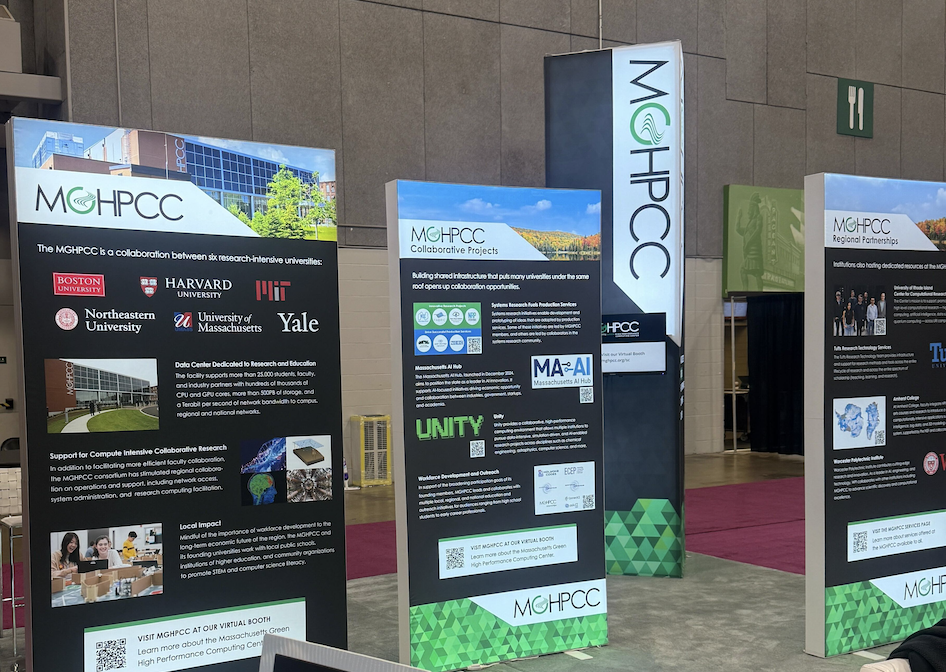
Center showcases cutting-edge HPC research and AI collaboration at annual conference.
Last month, the Massachusetts Green High Performance Computing Center (MGHPCC) once again participated in SC (formerly Supercomputing), the world’s largest high-performance computing (HPC) conference, held November 16–21 at the America’s Center Convention Complex in St. Louis, Missouri. MGHPCC booth featured nearly 80 computationally intensive research projects from its consortium members and partners, highlighting the transformative role of HPC in science, engineering, and AI innovation.
The MGHPCC exhibit illustrated the diversity of research enabled by its advanced computing infrastructure, spanning disciplines such as climate modeling, energy systems, medicine, materials science, health analytics, space exploration, and computing technologies. Visitors explored how HPC resources are accelerating breakthroughs in areas from drug discovery and quantum computing to sustainable energy solutions.
A major highlight was MGHPCC’s partnership with the Massachusetts AI Hub, which aims at expand access to sustainable HPC and data platforms critical for AI-driven research. This collaboration underscores MGHPCC’s commitment to supporting next-generation AI workloads while promoting energy-efficient computing practices.
SC25 brought together thousands of scientists, engineers, educators, and industry leaders to share advancements in HPC, networking, storage, and analysis. The conference featured technical sessions, tutorials, and an exhibit hall showcasing cutting-edge technologies. MGHPCC’s booth served as a hub for collaboration among leading universities, including Boston University, Harvard, MIT, Northeastern, the University of Massachusetts system, and Yale University, regional partners including the University of Rhode Island, Tufts University, Smith College, Olin College, Worcester Polytechnic Institute, and Bridgewater State, as well as private industry partners.
In addition to the in-person exhibit, MGHPCC offered a virtual booth experience, enabling global participants to explore featured projects and learn about the center’s state-of-the-art infrastructure. MGHPCC systems run millions of virtual experiments monthly, supporting tens of thousands of researchers throughout the region.
By showcasing its HPC-enabled research portfolio and AI initiatives at SC25, MGHPCC reaffirmed its role as a leader in sustainable, high-performance computing in support of academic research throughout the Northeast corridor. The center continues to drive innovation across academia, industry, and government, fostering collaborations that address complex challenges in science and technology.
URI Research Projects Featured at SC25 in the MGHPCC Booth University of Rhode Island, IT Services, News
YCRC Team members attend SC25 Conference Yale Center for Research Computing News
NET2 and NESE Debut at SC25 Network Research Exhibition with High-Speed Data Transfer MGHPCC News